GBTT Comment · Monetary Policy
The Inflation Mystery: How Central Bankers Forgot About Money
We spent hundreds of billions of pounds creating money during Covid. Inflation followed. Then came years of elaborate explanations for why the money had nothing to do with it. As the Bank of England quietly rediscovers broad money, Damian Pudner asks the question the models never could: what happens when policymakers stop watching the quantity of money?
For the best part of three decades, central banks have become increasingly sophisticated about interest rates, output gaps, labour markets, inflation expectations and forward guidance. They have built evermore complex DSGE and HANK models that try to replicate the economy and behaviours, employed armies of PhD economists and produced point forecasts to the nth decimal place.
Yet, oddly, the one thing they became less interested in is money. Not the notes and coins in your wallet, but what economists call broad money, the deposits held by households and businesses with commercial banks. Unlike quantitative easing (QE), which creates deposits when the central bank buys existing assets from the non-bank private sector, commercial banks create deposits when they lend. This is lending-driven money creation in today's economy. Those deposits are then channelled through financial markets and the wider economy with a lag, generally accepted to be between 18–24 months.
For too long now money has been treated almost as a relic of a bygone age by central bankers. Everyone knew it existed, but nobody particularly wanted to talk about it.
Thankfully, that is beginning to change.
The Bank of England's Monetary Policy Report now regularly devotes an entire box to broad money and, rather remarkably, recently acknowledged the problem rather neatly. The New Keynesian models that dominate modern central banking, it said, do not typically capture the longer-term role of money explicitly. Broad money can therefore provide a useful cross-check on the outlook for nominal spending and inflation.
Amazingly, it has taken three decades to rediscover this.
During Covid, the Bank expanded QE by £450 billion, pumping money directly into the economy. Broad-money growth subsequently accelerated to 15.4% in the year to February 2021.
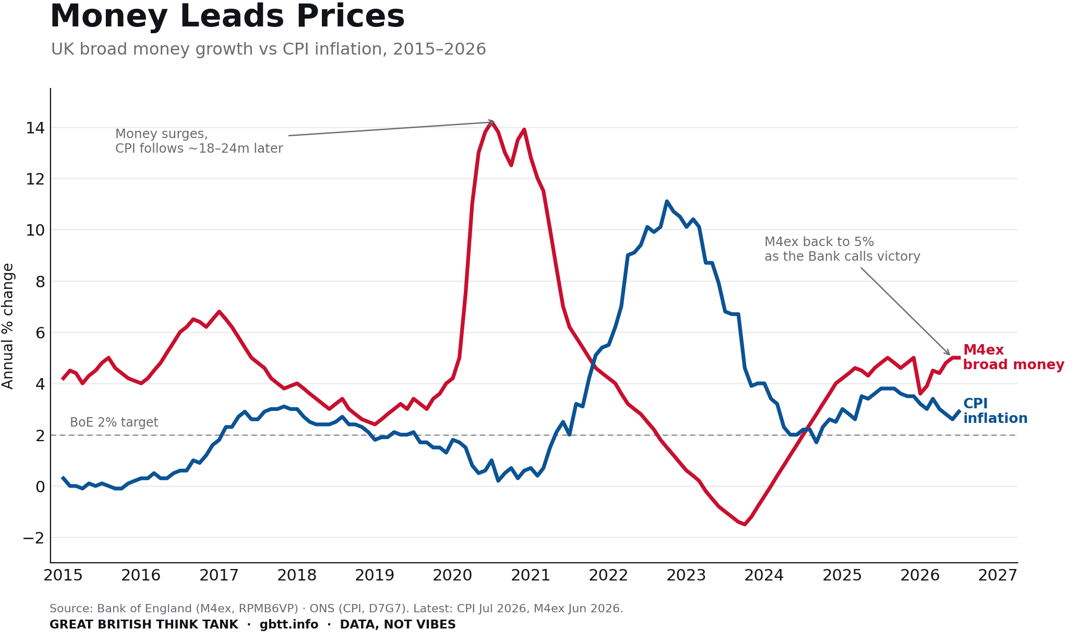
That additional money first spilled into financial assets, like equities and property. Then, as the economy reopened and people tried to run down savings, nominal spending accelerated and inflation followed, eventually reaching 11.1% in October 2022, its highest rate in four decades.
Obviously, we can't blame QE alone for the full increase in prices during that period. Energy prices increased in part due to the Russian invasion of Ukraine, and disrupted supply chains were also to blame. But neither explains why an external price shock became such a broad and persistent inflationary episode. For that, you need monetary accommodation.
Today, the money supply is growing at just under 5% annually. The Bank's own analysis says the ratio of broad money to nominal GDP is close to its estimated equilibrium, with no significant monetary overhang comparable with that following the pandemic.
That does not mean we have hit some magical number guaranteeing price stability. Sadly, nothing in economics is that straightforward. Monetary velocity changes. The demand to hold money changes. Credit creation matters.
But it does tell us something rather important: Britain is not currently experiencing anything resembling the monetary explosion of 2020–21. That should matter when the Monetary Policy Committee looks at today's inflation data. CPI rose to 2.9% in July, largely because household energy prices jumped following the latest Ofgem reset. They will no doubt rise again when the 4% rise kicks in from 1 October.
An economy suffering from excessive monetary growth is one thing, and rate rises are the right tool for it. An economy suffering a relative-price shock because imported energy has become more expensive is another, and rate rises cannot fix it. It simply cannot be sustained. And while raising interest rates can restrain domestic demand, it cannot produce a barrel of oil, generate a cubic metre of gas or help to reopen the Strait of Hormuz.
That doesn't mean central banks should ignore supply shocks completely. If an energy shock coincides with excessive and sustained money supply growth and increased nominal demand, monetary policy will need to tighten. That was essentially the danger in 2021–22. And that combination should be avoided at all costs.
But blindly responding to every rise in headline CPI with higher interest rates risks fighting yesterday's war.
History is full of examples of what happens when policymakers lose sight of the quantity of money.
The Heath–Barber boom of the early 1970s saw broad-money growth reach roughly 25% a year before inflation approached 25%. During the Lawson boom of the late 1980s, broad money grew at around 15% annually, helping inflate property and equity markets before tighter policy brought on a recession.
Japan's economic landscape in the 1980s offers a stark example of the effects of unchecked money supply growth. From 1986 to 1990, Japan's broad money expanded at an average annual rate of 10%, fuelling substantial increases in asset prices. The Nikkei 225 surged from around 13,000 points at the start of 1986 to nearly 40,000 at the beginning of 1990, while Tokyo land values rose 10.4% in 1986, 57.5% in 1987, and 22.6% in 1988, more than doubling in just three years. However, subsequent monetary tightening by the Bank of Japan led to a dramatic reversal: asset prices plummeted, land prices fell by more than 50% in three years, and the Nikkei 225 lost half its value by October 1990. This resulted in a prolonged economic malaise known as the ‘Lost Decade’. During this period, Japan's real GDP growth dwindled to an average of just 1.2% per year, markedly below the previous decade's rates.
Similarly, during the Great Depression (1929–1933), the United States experienced a catastrophic collapse in the broad money supply by about one-third, which precipitated a steep decline in asset prices and triggered widespread bank failures and a severe decline in economic activity and deflation. This period vividly illustrated the severe consequences of rapid decreases in money supply, meticulously documented by Milton Friedman and Anna Schwartz in their seminal work, A Monetary History of the United States, 1867–1960.
The lesson is not that central banks should replace one mechanical rule with another. Milton Friedman's old constant-money-growth rule belongs to an economy with a much more stable relationship between money, income and financial intermediation than the one we inhabit today.
But money matters.
Interest rates are a price. They are not, by themselves, a description of whether monetary conditions are tight or loose.
Central bankers need to look simultaneously at money, credit, nominal spending, asset prices and the supply side of the economy. Interest rates are a price. They are not, by themselves, a description of whether monetary conditions are tight or loose.
We spent hundreds of billions of pounds creating money during Covid. Inflation followed. Then came years of elaborate explanations for why the money had nothing to do with it. The strange thing is that none of this should be controversial.
Sources & Further Reading
- Bank of England, Money and Credit, February 2021: broad money (M4ex) growth of 15.4% in the year to February 2021.
- Bank of England, Money and Credit, June 2026: M4ex annual growth of 4.8%, the "just under 5%" in this piece. See also GBTT's data release on the June figures.
- Bank of England, Monetary Policy Report: the broad-money box acknowledging that New Keynesian models "do not typically capture the longer-term role of money explicitly".
- ONS, Consumer Price Inflation, July 2026: CPI at 2.9%, driven by household energy. See also GBTT's July CPI release.
- Ofgem: energy price cap rising 4% from 1 October 2026.
- Friedman & Schwartz, A Monetary History of the United States, 1867–1960: the definitive account of the Great Depression's monetary collapse.
- GBTT, The Iran Energy Shock and CPI vs RPI: GBTT's own work on imported energy shocks and how Britain measures inflation.