This is Part I of a series on my reflections on aspects of ancient history which have resonance today. They will range across economics, politics and culture. All comments welcome.
“For our history now descends from a kingdom of gold to one of iron and rust, as affairs did for the Romans of that day.”
Cassius Dio, Roman History, Book 72
Dio, a senior Roman statesman writing in the 210s and 220s AD, made that pronouncement regarding the death of Marcus Aurelius in 180AD and what followed. Marcus Aurelius was the last of what have been termed ‘the Five Good Emperors’, who oversaw the what is conventionally viewed as the high point of the Empire. He was succeeded by his son Commodus (r. 180-192), under whom a decline began which steadily accelerated, ultimately developing into what is today known as the Crisis of the Third Century.
In contrast to the relative peace, stability and prosperity of the First and Second Centuries, the Third was one of chronic civil wars, disorder and economic turmoil. Dio was in fact writing before the real Crisis began, though its dynamics were already becoming established and entrenched by the 210s. There were many aspects to the Crisis of the Third Century; here I will focus on the collapse of Roman money, which we can visibly see through their coins, and how it happened. It hits rather close to home; as the saying goes, history does not repeat but it does rhyme.
From gold to iron and rust
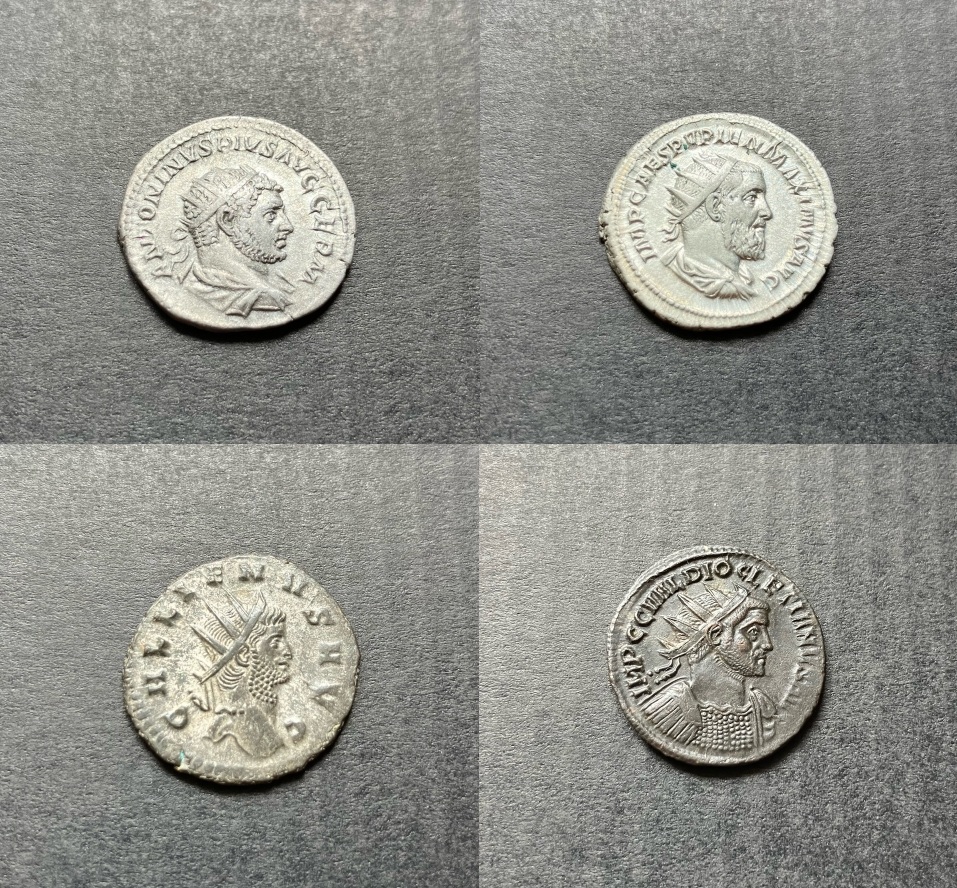
I collect ancient coins, with one of my collections being the Roman Emperors from Augustus to Constantine, amounting to three centuries of monetary history. Until the end of the second, the silver content of the coins is relatively consistent. After that, through the third, it rapidly nosedives, as coins are debased (silver removed) and issued in ever greater quantities; by the late Third Century AD, silver coinage had been largely driven out of circulation, replaced by vast amounts of low-value bronze. This was nothing less than monetary collapse — or, as we may say, runaway inflation.
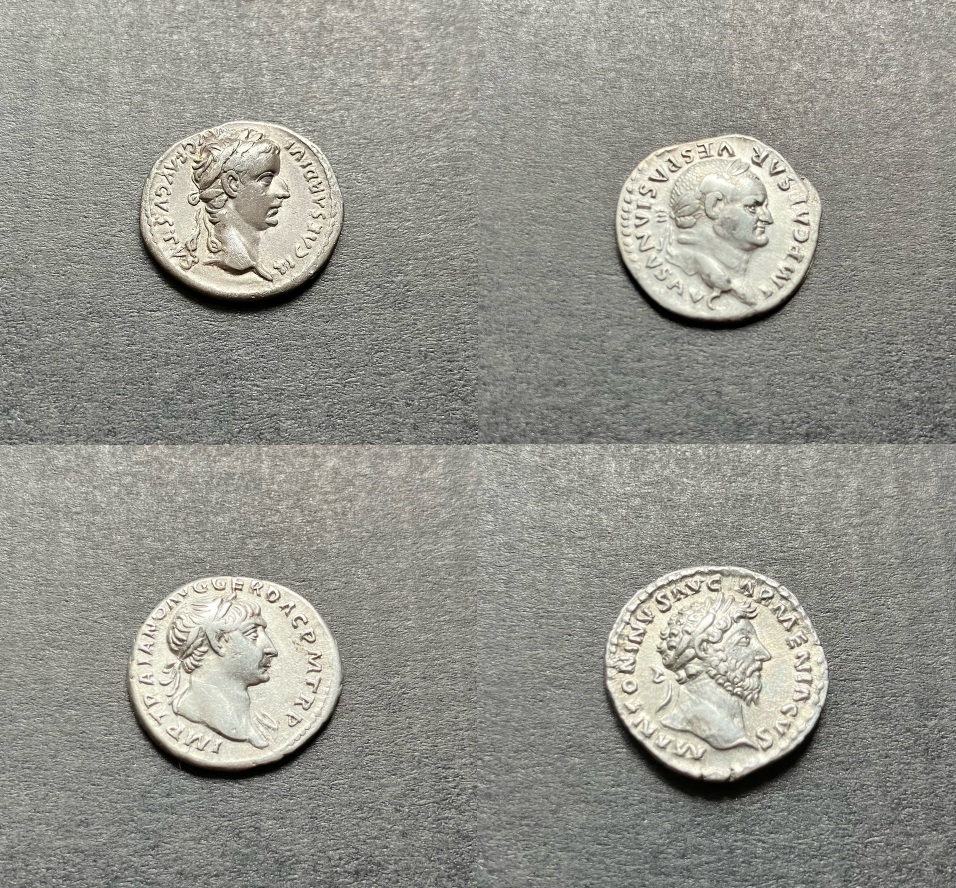
The silver denarius was the anchor of the Roman monetary system. Augustus (r. 27BC-14AD), the first emperor, reformed the coinage and defined it to be 1/25th of the gold aureus, and a ‘denarius a day’ seems to have been a reasonable income at that time.[1] The silver content of the denarius modestly declined between Augustus and Marcus Aurelius (r. 161-180), from c.95% to c.80%, which seems to more reflect the expansion of the economy and the consequently necessary monetary growth rather than inflationary minting.
After Marcus Aurelius, the decline sets in fast. Silver content falls from c.80% in the 170s to c.50% by the 230s, after which the denarius is largely replaced by the ‘double denarius’, known today as the antoninianus, seemingly with a face value of two denarii[2] though only ¾ of the silver, which is tantamount to devaluation. That itself was rapidly debased, until by the 270s it was almost entirely bronze (<5% silver) with just a thin coating (‘wash’) of silver; in many examples, this has worn off it was so thin.
This marks nothing less than monetary collapse, indicating runaway, if not hyper-, inflation. Emperor Diocletian’s (r. 284-305) Edict on Prices, issued in 301, which set a swathe of maximum prices to try to control inflation (sound familiar?), implicitly defined the denarius (now purely notional) as being about 1,450 to an aureus (also discontinued).[3] Comparing that to the old rate of 25:1, which still held in the 180s, suggests that prices rose about 60x in a century or so. The price caps in the Edict on Prices large conform with this overall figure. Put another way, Roman money lost c.98% of its value over the Third Century. Almost literally from gold to iron and rust. That is at official rates of course, and we know well enough how governments have a penchant for massaging inflation figures downwards.
Your average Roman was certainly not 60x wealthier in 300AD than in 180AD.
A fiscal and political choice
Monetarists would diagnose this as being caused by excessive growth of the money supply from issuing too much money (through debasement). At heart, though, the problem was fiscal and political; the emperors did it to fund ballooning expenditure, primarily on pay and donatives (bonuses) to soldiers to buy their loyalty, following the advice of the emperor Septimius Severus (r. 193-211) to his sons, the Geta (r. 211) and Caracalla (r. 211-217) of Gladiator II fame, to ‘enrich the soldiers, scorn all others.’[4] In other words, throw money at your base and forget the rest.
The Edict on Prices is a fascinating read. Its preamble is an excoriating condemnation of greedy profiteers and gougers, whom it blames for the inflationary crisis:
Greed raves and burns and sets no limit on itself. Without regard for the human race, it rushes to increase and augment itself not by years or months or else days, but almost by hours and very moments.
…
But unmastered insanity has one desire: to have no soft spot for a necessity all share. Unprincipled and licentious persons think greed has a certain sort of obligation (greed that swells and roils with rapid fires), in ripping up the fortunes of all, to lose the need rather than the will to continue.
…
Who has so insensible a heart or has removed himself so far from human feeling that he can fail to know — that he has not in fact felt in commercial affairs, whether done in trade or dealt with in the cities’ daily exchange — to what an extent shameless pricing has spread? Neither abundance of goods nor the bounty of good years tempers this unrestrained lust for stealing!
And so it goes on. Recall the speed with which politicians today leap to blame businesses for rising prices and inflation, calling them profiteers and urging windfall taxes and price caps. All the while, it is they who are responsible. History does rhyme. Another rhyme: like with most maximum prices since, the Edict failed and was, within a few years, seemingly ignored.
The process of debasing coinage to issue more and so fund out-of-control spending is the straightforward equivalent to debt monetization (now re-branded as ‘quantitative easing’) and financial repression (artificially low interest rates to support government borrowing) in modern monetary policy. Consider this: the apparent Roman monetary collapse of the Third Century amounted to an average annual inflation rate of c.4%. In the UK, the average inflation rate since 1945 has been c.4.6%, per the Bank of England i.e. the pound sterling has lost over 97% of its value in 70 years. Are we almost 40x[5] richer now than we were in 1945? Certainly not. Surely this is monetary collapse?
Roman money lost c.98% of its value over the Third Century. Sterling has lost over 97% of its value since 1945. Surely this is monetary collapse?
The most pernicious tax of all
Inflation is the most subtle and pernicious way to erode living standards. The wealthy, who have assets that re-price, are largely immune; it is the mass of ordinary folk, with few assets (or immobile ones) and reliant on salaries which are devalued by inflation, who see themselves priced-out of lifestyles once viewed as standard. The decline is almost imperceptible at first, a little here and a little there; buying the supermarket own brand, cutting a few days off the holiday, holding out a couple of weeks longer before putting on the heating; we are very good at adapting to incremental hardship. It is only when one looks back five or ten or twenty years that the scale of the decline becomes clear. One can imagine your hard-pressed Roman in c.270AD, say, having the same revelation.
The Roman Empire of the Third and Fourth Centuries was a poorer, more miserable place than the High Empire of the Second Century. The population, hard-hit by the Antonine Plague of the 160s and 170s, did not recover, while trade declined, taxes increased, and cities (especially in the Western Empire) shrank as the economy declined. Large swathes of the population became tied to the land and landowners given power over them, the early stages of the serfdom of the Middle Ages. The monetary collapse was not the sole cause of the Crisis of the Third Century, but part of a wider, vicious cycle of economic and political deterioration.
Inflation is always a choice. It was the choice of the Third Century Roman emperors to splurge on their political base (the soldiers), bankrupting the Roman State and saddling the people with worthless money to pay for it. It is much the same choice of modern governments to pour money into welfare, pensions and the NHS in pursuit of popularity (and therefore votes) with little to show for it, while the national debt balloons and inflation smoulders away. Spending, when used with intent for defined policy, is often good; dispensing ‘freebies’ and largesse in myopic (and often vain — the emperors of the Third Century, like the popularity of modern governments, did not last long) attempts to generate better poll ratings is invariably bad.
The full implications of our monetary collapse for living standards were for a while deferred by productivity improvements and cheap imports, which were not available to the Romans. That road has now run out at precisely the time the fiscal, monetary and political deterioration (they are inextricable) is accelerating.
Since 2008, we have increasingly felt the full force of monetary collapse, as the prices of essentials – housing, energy, food, transport – have inexorably risen while wages have remained stagnant, steadily tightening the screw on our living standards (see Malthusian Fetters). As the fiscal pressure becomes ever more acute, the attractiveness of financial repression, debt monetization and tax rises (the Third Century recipe) to government will grow, with commensurate declines in living standards certain to follow. I discussed this in more detail in The New Horsemen.
If history is a mirror to us in the present, looking into that mirror one might see the following message: welcome to the Crisis of the Twenty-First Century. As a Roman would say, para te — get ready.
QCMP
Notes & Sources
- Jesus himself uses it — see Matthew 20, for example. In the KJV, ‘denarius’ is rendered ‘penny’; the pre-decimal symbol for the penny, d., refers to the denarius.
- We do not know for sure that it had a face value of two denarii, though stylistic elements, most notably the radiate (a sunburst crown, like that worn by the Statue of Liberty) bust of the emperor which conventionally indicates a double denomination, strongly suggest it was.
- The Edict defined a Roman pound of gold to be worth 72,000 denarii. The solidus, the new standard gold coin, was equal to 1,000 denarii. A solidus was therefore set at 72 to a Roman pound of gold, compared to the aureus which (by c.200AD) was about 50 to a Roman pound, having been set at 45 by Nero (r. 54-68). One late aureus then ≈ 1.44 solidi, so one late aureus was about 1,440 denarii.
- Cassius Dio, Roman History, Book 77.
- Prices have risen, on average, c.38x since 1945, per the Bank of England. For comparison, US prices have risen c.19x since 1945, per the Federal Reserve.
- Originally published by the author on his Substack: Echoes of Antiquity I: Iron and Rust. Co-published by GBTT with permission. Coin photographs © the author.